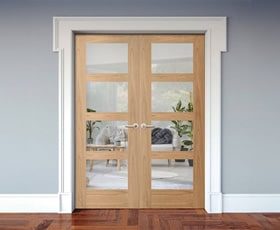


When you’re choosing a new external timber door, one of the questions you might ask is:
“How thick should the door be?”
There isn’t one thickness that is right for every door, but for most quality external timber doors, 44mm is a very good choice.
It gives you a strong, solid door without making it unnecessarily heavy.
Why does the thickness matter?
An external door has to deal with the British weather all year round.
Rain, wind, changes in temperature and changes in humidity can all affect timber.
A well-made door needs to be strong enough to cope with these changes while also providing good security and insulation.
The thickness of the door is one part of this, but the way the door is made is just as important.
Is 44mm thick enough?
Yes. 44mm is commonly used for quality external timber doors and is suitable for many different designs.
It works well for traditional entrance doors, modern doors, glazed doors and many other bespoke designs.
It also provides enough depth for many types of hinges, locks and glazing.
For particularly large or heavy doors, a different thickness may be more suitable. This is something that should be considered when the door is designed.
Does a thicker door mean a stronger door?
Not always.
It is easy to think that a 50mm or 60mm door must be better than a 44mm door simply because it is thicker.
But there is much more to a good external door than its thickness.
The timber, joints, construction, frame, hinges, locks and finish all play an important part.
A well-made 44mm solid timber door can be extremely strong and durable.
What about security?
The thickness of the door is only one part of security.
The door, frame, hinges and locking system all work together.
A strong door fitted into a well-made frame with good-quality security hardware can provide an excellent level of security.
This is particularly important with bespoke timber doors, where the whole door set can be designed around the size and requirements of the opening.
Does a thicker door prevent warping?
Unfortunately, simply making a door thicker doesn’t guarantee that it won’t move.
Timber is a natural material, so it will always react to changes in moisture and humidity.
Good timber, careful construction and the correct finish are all important when making an external door.
How the door is fitted and how exposed it is to the weather can also make a difference.
What thickness is best for oak doors?
For a bespoke solid European oak external door, 44mm is often an excellent choice.
Oak is naturally strong and durable, making it a popular material for external doors.
The exact construction can then be tailored to the size and design of the door.
A standard-sized entrance door may have different requirements to a large pair of French doors or a wide entrance door.
So, what is the best thickness?
For most external timber doors, 44mm is a great starting point.
However, there is no single thickness that is best for every door.
The size of the door, the design, the timber, the glazing, the locks and the way the door is constructed all need to be considered.
That’s why a bespoke door can be designed specifically for your home rather than simply choosing a standard off-the-shelf size.
Looking for a bespoke solid timber external door? Contact LSC Joinery to discuss your requirements and get a free quote.